She refused to let me photograph her filling her water bucket in Kagbeni. I offered money, thinking that was the issue. She laughed and walked off. Fifteen minutes later I was in her courtyard, drinking raksi she'd made herself, watching her husband braid her hair. She hadn't wanted a transaction — she'd wanted a person, not a tourist with a camera.
That's the Mustang I build trips around, and it's why "which Mustang trek should I do?" doesn't have one answer. Upper, Lower, and Damodar Kunda aren't a difficulty ladder. They're three different trips that happen to share a valley.
Quick answer: Mustang isn't one trek — it's three, and they're not interchangeable. Lower Mustang (Jomsom–Kagbeni–Muktinath, 5–6 days) needs no restricted-area permit and suits most fit travellers. Upper Mustang (into Lo Manthang, 10–17 days) requires a $50/day Restricted Area Permit and a licensed guide, and rewards travellers who want the walled city and sky caves properly, not glimpsed. Damodar Kunda (12–14 days) pushes through Upper Mustang territory to a sacred lake at 4,890m — built for experienced trekkers already past their first Himalayan trip. Below is who each one actually fits.
The three Mustang Routes, side by side
| Lower Mustang | Upper Mustang | Damodar Kunda | |
|---|---|---|---|
| Duration | 5–6 days | 10–17 days | 12–14 days |
| Max altitude | ~3,800m (Muktinath) | 3,840m (Lo Manthang) | 5,400m (Damodar Kunda) |
| Permit required | ACAP only | ACAP + Restricted Area Permit | ACAP + Restricted Area Permit |
| Solo trekking | Yes | Yes, with guide (since March 2026) | Yes, with guide |
| Built for | An unhurried look at the Kali Gandaki valley | The walled kingdom and deep cultural immersion | A high-altitude pilgrimage into genuine remoteness |
Lower Mustang
Who it's for
Travellers with 5–7 days total, or anyone using this as an acclimatisation leg or add-on to an Annapurna Circuit trip through Muktinath. Also the right call if someone in your group has a hard ceiling on altitude — this route never goes past 3,800m.
What it actually feels like
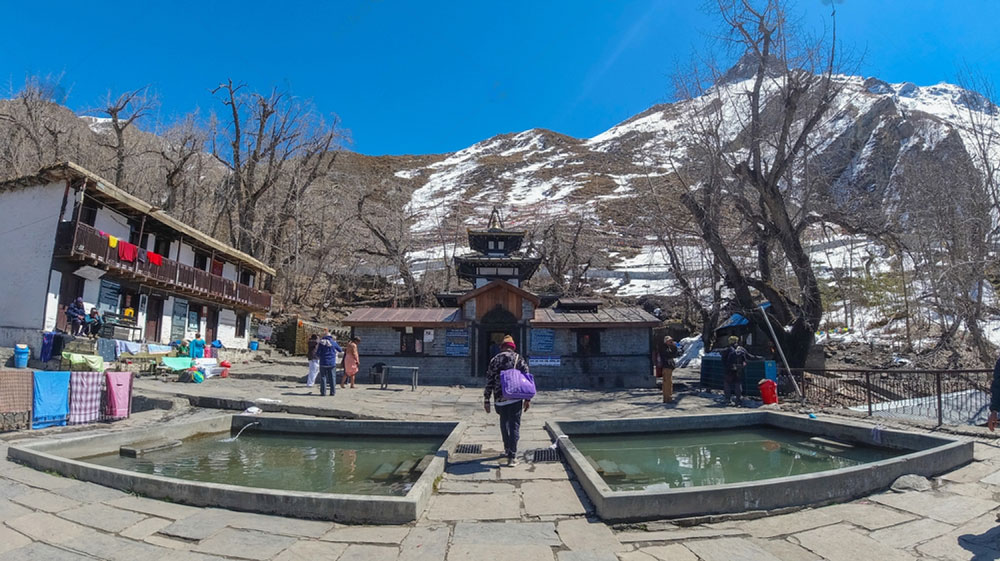
This gets filed under "the easier option," and that undersells it. The Kagbeni stretch alone has a 15th-century monastery — Kag Chode Thupten Samphel Ling — with monks still running rituals inside, not staged for the trail. Marpha, further along, has been producing apple brandy and apple wine for decades out of small, family-run distilleries; the brandy's rough, the wine's better than people expect, and nobody there is performing "authentic village" for a tour group. Muktinath closes the loop — 108 water spouts pilgrims have walked to for centuries, and the Jwalamai Temple's flame, which has been kept burning inside for longer than anyone can tell you exactly.
Route, day by day
Day 1 — Kathmandu: Arrival, hotel transfer, overnight to prepare for the trek.
Day 2 — Kathmandu to Jomsom: 25-minute flight to Pokhara, then a 15-minute onward flight to Jomsom, the trek's starting point. (Overland alternative: bus to Jomsom via Gongabu Buspark, 375km, roughly 25–28 hours depending on road conditions.)
Day 3 — Jomsom to Kagbeni: 10km, 4–5 hours, to 2,858m. Traditional Tibetan-style houses, first real mountain views of the trip.
Day 4 — Kagbeni to Muktinath: 13km, 5–6 hours. The steepest day of the route, ending at the temple complex.
Day 5 — Muktinath to Jomsom: 13km, 5–6 hours, retracing the Kali Gandaki valley with the Himalayan range in view the whole descent.
Day 6 — Jomsom to Kathmandu: Flight to Pokhara, then onward to Kathmandu — both legs offering close-up views of the Annapurna and Dhaulagiri ranges from the window.
Cost, permits, and duration
5–6 days on the trail, 6 days total including arrival and departure. Only the ACAP is required — $30/person — since the route stays entirely south of Kagbeni. No Restricted Area Permit, no group minimum. No guide requirement for the permit itself, but I'd still put one with you — the difference isn't route-finding, it's whether you walk past that monastery or spend fifteen minutes actually inside it.
When to go
Spring (March–May) and autumn (September–November) for the clearest trails and firmest footing on the Kagbeni–Muktinath climb. Because Mustang sits in the rain shadow of the Annapurna and Dhaulagiri ranges, this route stays walkable through the monsoon too — a real advantage if June–August is what your calendar has to offer.
Upper Mustang
Who it's for
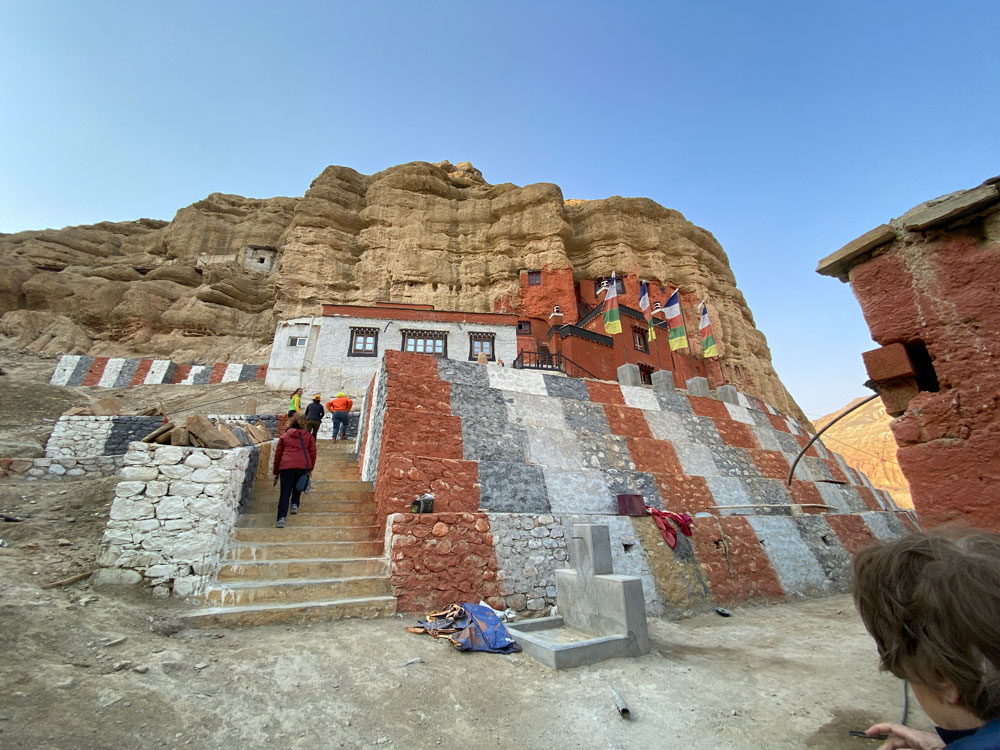
Travellers with 10+ days, real interest in Tibetan Buddhist culture rather than scenery alone, and no hard ceiling on altitude tolerance. Solo travellers are welcome here too now — as of March 2026, the old two-person minimum was dropped, though you'll still need a licensed guide and the standard permits. Read more on solo travel to Mustang.
What it actually feels like
I had an Israeli family book this with no hiking planned into the itinerary at all — jeep tour, comfortable, low effort by design. Day three, they asked my guide if they could break from the plan and hike instead. We did: Dhakmar cliffs, the sky caves, Ghar Gompa monastery. By the end they were wrecked, and they called me afterwards, unprompted, just to say thank you for letting the plan change.
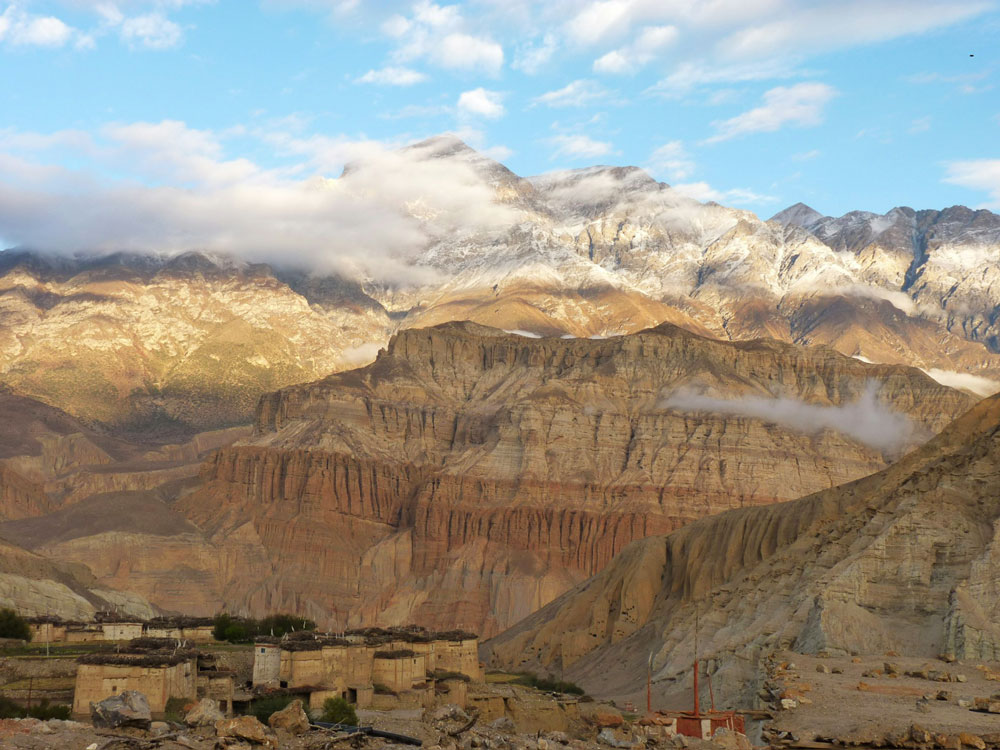
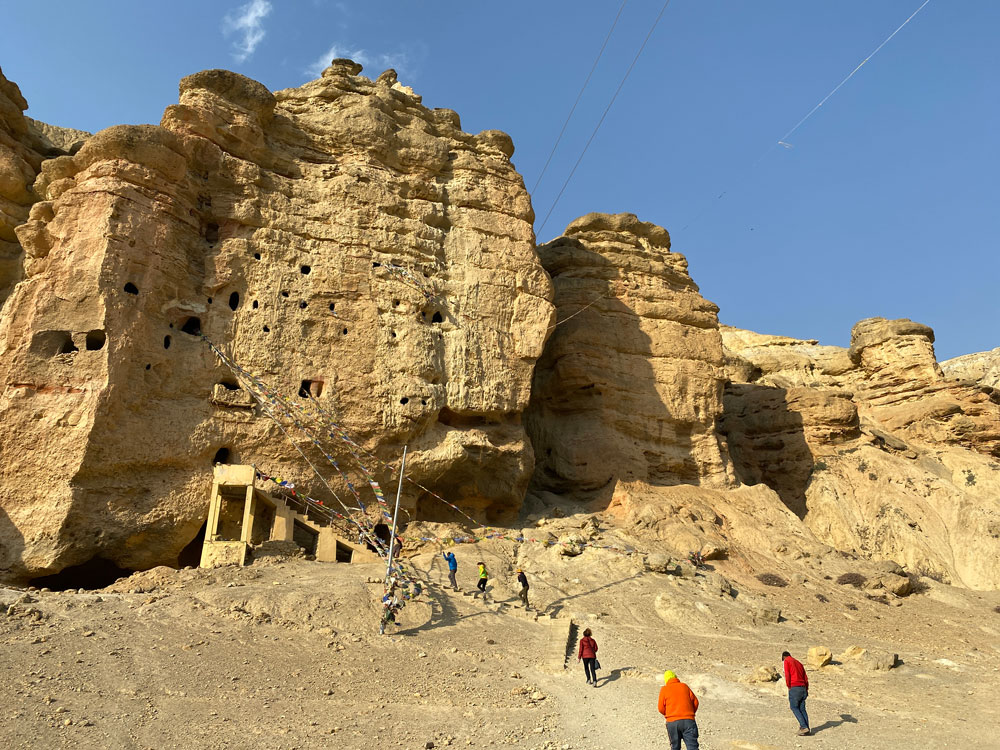
The sky caves at Chhoser are the part people underestimate before they've seen them — chambers cut into a vertical cliff face over 3,000 years ago, hundreds of hand-cut openings stacked row on row, used across centuries as burial sites, meditation chambers, manuscript repositories. I build two full days into Lo Manthang itself for exactly this reason; one day gets you the walled city's outline, two gets you inside it.
Route, day by day (trekking itinerary)
Bus Kathmandu to Pokhara, then flight to Jomsom, where the trek begins.
Jomsom to Kagbeni, the gateway to the restricted area.
Kagbeni onward through Chaile, Syangboche, Ghami, and Charang before reaching Lo Manthang — each stage a full trekking day through increasingly barren, high-desert terrain.
Two full days in Lo Manthang: the royal palace, active monasteries, the walled city's narrow streets, plus the Chhoser sky cave detour.
Return retraces through Dhakmar, Geling, and Chhuksang back to Jomsom — different light, different angle on terrain you've already crossed once.
Flight Jomsom to Pokhara, then the scenic drive back to Kathmandu.
Jeep alternative: For travellers short on time or less confident at altitude, the same route runs as a 5–7 day jeep tour — Kathmandu to Lo Manthang and back, with stops built in along the way. Cost runs roughly $100–250/day depending on jeep type, with the drive itself taking 4–6 hours each way once you're past Jomsom. As of 2026, most of the road is paved; only a 15–20km stretch between Beni and Kagbeni remains off-road — dusty, but manageable, not the bone-rattling drive it used to be.
Cost, permits, and duration
Full trekking route: 17 days. Jeep-assisted version: 5–7 days. Requires both ACAP ($30) and the Restricted Area Permit ($50/person/day) — the RAP has to be processed through a licensed agency in Kathmandu or Pokhara before you travel, not at the Kagbeni checkpoint itself. Lo Manthang sits at 3,840m, so acclimatisation gets built into the ascent stage by stage, not treated as a single rest day.
When to go
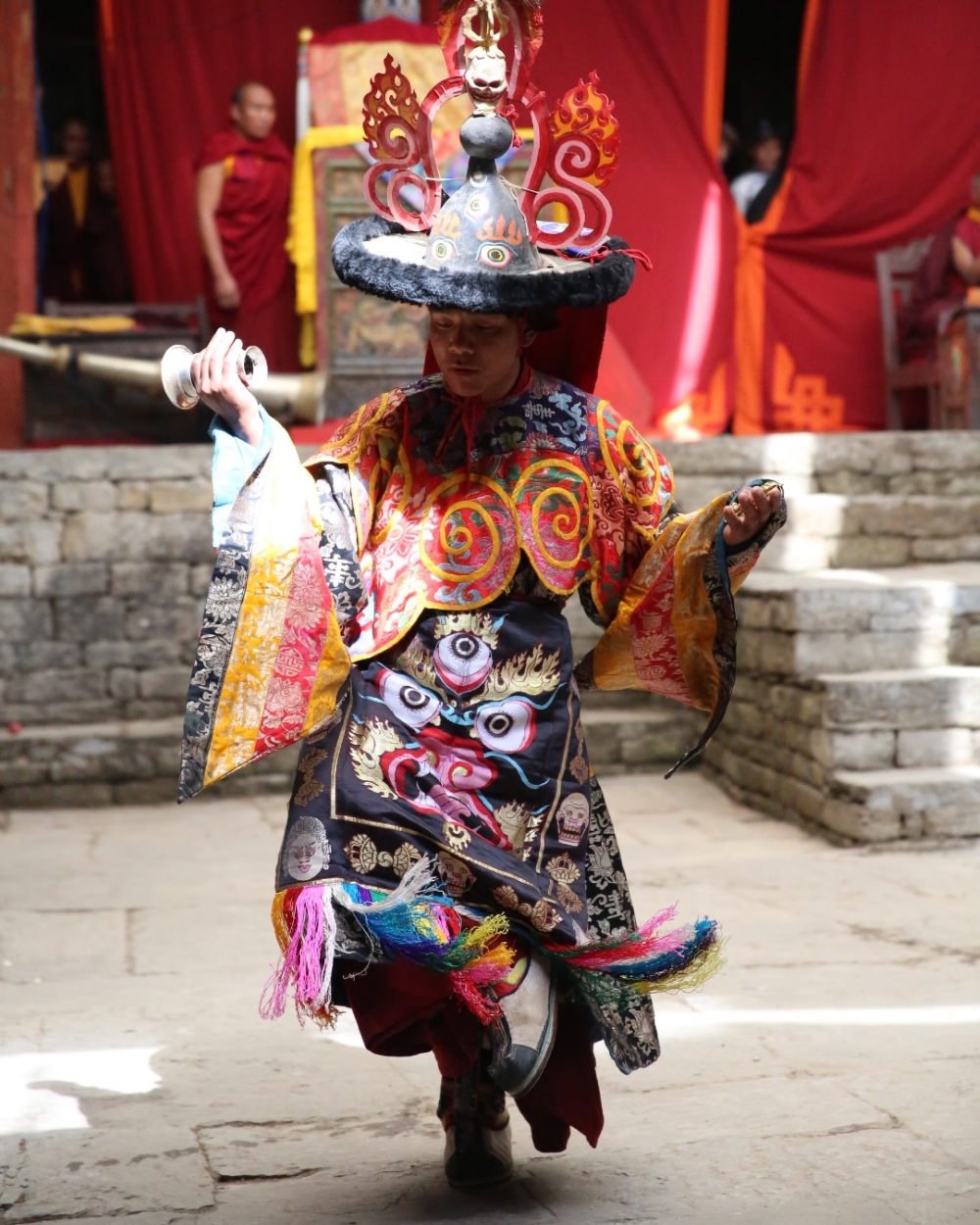
Spring lines up with the Tiji Festival in Lo Manthang — three days of masked dance depicting the region's founding myth. Autumn gives the clearest skies. Summer is a legitimate, quieter window given the rain-shadow effect, though some lodges run reduced schedules — confirm ahead if you're travelling June through August.
Full itinerary and route detail:Upper Mustang Trek
Getting there and current road conditions:how to travel to Mustang
Damodar Kunda
Who it's for
Trekkers who've already done Upper Mustang, want more remoteness and less infrastructure, and have the fitness and altitude experience to back that want up. Not a first Himalayan trek — the jump from Lo Manthang's 3,840m to Damodar Kunda's 5,400m in the space of a few days is a real physiological demand.
What it actually feels like
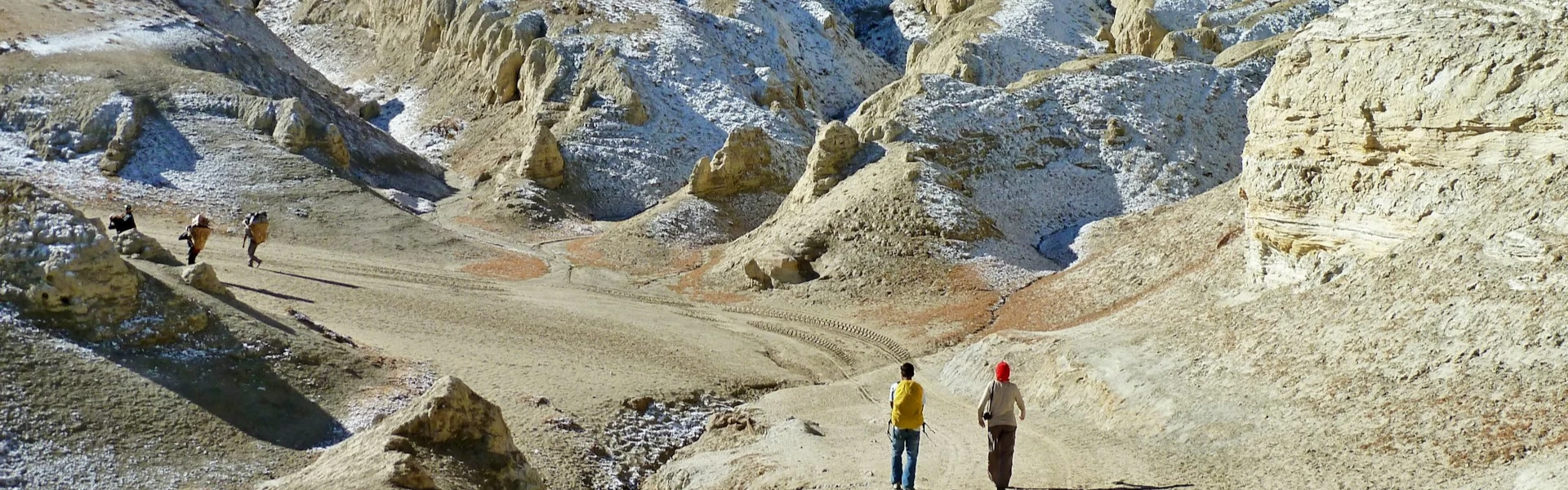
This is the trek I recommend least often, on purpose. It shares Upper Mustang's route as far as Lo Manthang, then keeps going — past the point where most trekkers turn back, into tented-camp territory with no village infrastructure to lean on. Damodar Kunda itself, at 4,890m, is a lake pilgrims believe cleanses sin according to the Barah Puran; the cold, the altitude, and the silence out there aren't incidental to that belief; they're part of what makes it feel earned.
Cost, permits, and duration
12–14 days. Same permit structure as Upper Mustang — ACAP plus Restricted Area Permit — since the route crosses the same restricted territory before continuing past it. Fitness prep matters here in a way it doesn't for the other two routes: sustained endurance across multiple 7–9 hour days at altitude, not just one hard push. A guide who specifically knows this route — not just Upper Mustang generally — matters more here than anywhere else in the region.
When to go
Same spring and autumn windows as Upper Mustang, with the August full moon as the one exception worth planning around — the Yartung Festival hits Gelling and Chhusang on the way through, horse races and religious ceremony, a different register entirely from Tiji's masked dance.
Permits, updated for 2026
ACAP (Annapurna Conservation Area Permit): $30/person, required for all three routes.
RAP (Restricted Area Permit): $50/person/day, required only past Kagbeni — Upper Mustang and Damodar Kunda. Must be processed through a licensed agency in Kathmandu or Pokhara before you travel. It cannot be arranged at the Kagbeni checkpoint itself.
Solo trekking: permitted since March 2026, provided you're with a licensed guide.
Travel insurance checkpoint: new for 2026 — proof of travel insurance is now checked as part of the permit process. Have it sorted before you arrive.
Full breakdown, including SAARC vs. foreign national ACAP pricing: Mustang permit guide.
How to actually decide
Don't sort this by difficulty. Sort it by what you're trying to get out of the trip.
If you want a genuine, unrushed encounter with the region and you're working with a week or less, Lower Mustang gives you that without the Restricted Area Permit or the extra altitude commitment. If Lo Manthang itself — the walled city, the sky caves, the sense of stepping into a place that kept the outside world out on purpose — is the actual draw, that's Upper Mustang, worth the extra days. If you've already done Upper Mustang and you're chasing remoteness most travellers never reach, Damodar Kunda is there for that, but not before.
Still unsure which fits your dates and fitness? Get in touch, and we'll build it around what you actually want — five minutes, not a sales call.
Read more on How to travel Mustang.
FAQs
Can I trek Mustang solo?
Yes, as of March 2026. The previous rule requiring a minimum of two travellers was removed. You still need a licensed guide and standard permits for Upper Mustang and Damodar Kunda; Lower Mustang has never required a group minimum. Guide on solo travel to Mustang.
Do I need a Restricted Area Permit for Lower Mustang?
No. Lower Mustang, up to Kagbeni and Muktinath, only requires the ACAP. The RAP applies only north of Kagbeni, on the Upper Mustang and Damodar Kunda routes.
What's the best time of year to trek Mustang?
Spring (March–May) and autumn (September–November) offer the clearest skies. Because Mustang sits in the rain shadow of the Annapurna and Dhaulagiri ranges, it's also trekkable through the monsoon, when trails elsewhere in Nepal are washed out.
Which Mustang trek is hardest?
Damodar Kunda, by a wide margin — 12–14 days with a high point of 5,400m. Upper Mustang tops out at 3,840m and is moderate; the challenge there is sustained daily walking rather than technical terrain. Lower Mustang is the most accessible of the three.
Can I combine Lower and Upper Mustang in one trip?
Yes — most Upper Mustang itineraries pass directly through Lower Mustang's route (Jomsom, Kagbeni) on the way in and out, so it's less a choice between them and more a question of how far north you continue.
Conclusion
Three routes, one valley, and the only wrong choice is picking based on which sounds most impressive rather than what you're actually there for. Lower Mustang isn't a warm-up. Upper Mustang isn't the only "real" version of the trip. Damodar Kunda isn't for proving something. Each one does a specific job, and the trek that fits you is the one that matches the time you have and the reason you're going, not the one with the best name recognition.
If you're still weighing it, that's normal — most people are, until they talk it through with someone who's actually walked all three. Reach out and tell me what you're looking for, and I'll tell you straight which route gets you there.