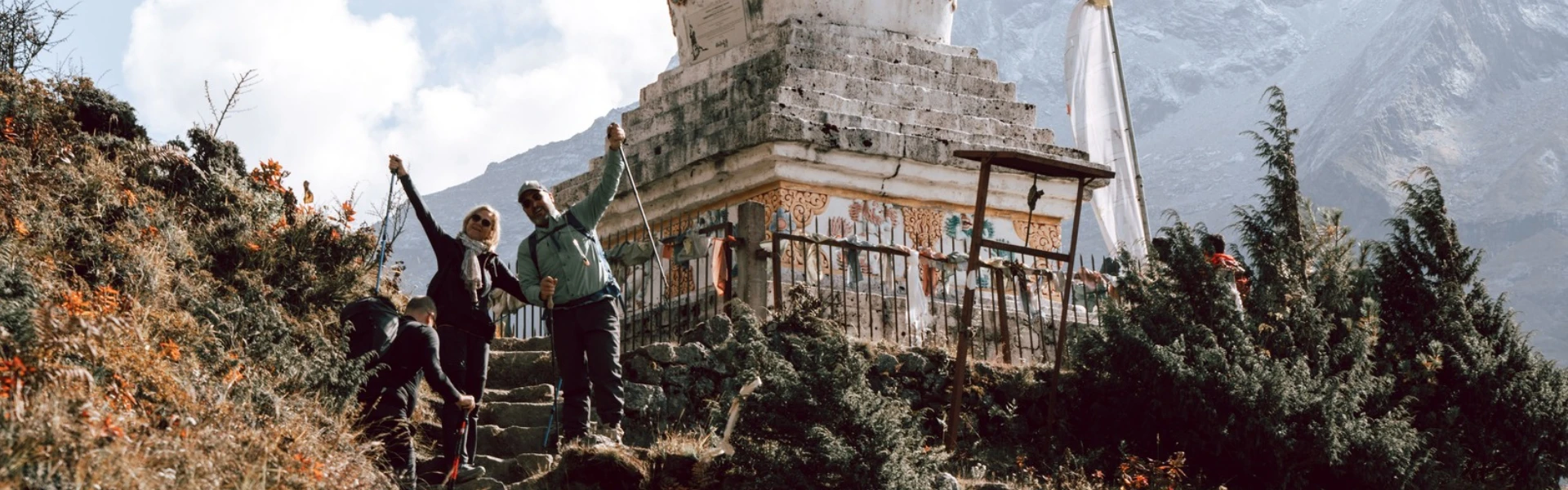
The Details That Set Our Treks Apart
A. Guide Selection & Briefing
Why Guide Quality Matters More Than Anything
The single most important factor in a trek isn't the lodge or the itinerary. It's the person walking beside you for 8-10 hours a day.
Here's what we look for:
Skill + Character We hire guides who know the mountains, yes. But we also look for guides who listen more than they talk. Who notices when you're struggling and asks instead of assuming. Who remembers details about your life and references them days later?
Examples of what character means:
A guide who brings a guide-assistant on steep downhills not because it's policy, but because he watches how you move and anticipates what you need
A guide who knows the answer to your question but asks why you're asking first, because the answer changes based on what you're actually seeking
A guide who suggests skipping the "famous" viewpoint because he knows the light will be better in two hours, and you'll be fresher then
Pre-Trek Briefing Process
Initial Consultation Call (30-45 min)
We ask about your travel history, your physical fitness, and your emotional expectations
We listen for what you're not saying (anxiety about altitude, desire for solitude, need for challenge)
We discuss your preferred pace, interaction style, and interests
Detailed Briefing Document
We write up your preferences and send them to your assigned guide
The guide reads about your trek before you arrive
He has time to think about how to approach it
Guide Assignment
Guides aren't rotated. You get the same person the whole trek
We choose guides based on personality fit, not just credential fit
We discuss with you in advance if there's a specific guide type you want
Pre-Trek Check-In
Two days before arrival, your guide calls you
You talk about the weather, what to pack, and what he wants to know
By the time you meet at the airport, you're already in conversation
What This Means On The Trail: By day two, your guide knows you better than most people in your regular life. He knows your pace. He knows what makes you laugh. He knows if you're struggling with altitude or just tired. He adjusts accordingly—without being asked.
B. Lodge Strategy: Location Over Fame
Why We Rarely Recommend The Most Expensive Hotels
Here's a surprising fact: the most famous luxury lodges in Nepal aren't always on our booking list.
Six Senses. Amankora. They're beautiful. But they're also designed for a specific aesthetic, and that aesthetic isn't always aligned with deep trekking.
Here's what we prioritise instead:
1. Location A lodge matters because of where it sits. A mediocre lodge in the right location (faces a valley, overlooks a village, sits on a ridge) is worth more than a fancy lodge in a nowhere place.
We have a partner lodge near Dingboche that's small and simple. But it's positioned to watch the sunset light move across Ama Dablam and Makalu simultaneously. That moment is worth more than heated toilet seats.
2. Continuity We work with lodges we know and trust. Usually family-run. Usually 10-20 years in operation. The owners remember clients. The staff have stability.
This changes the experience. You're not part of a rotation. You're a guest.
3. Operational Philosophy We choose lodges whose operators think as we do. They source locally. They invest in their staff. They care about the guest experience as a relationship, not a service metric.
4. Shared Values Luxury to us doesn't mean "most amenities." It means "understands what we're trying to do."
A lodge owner who hand-bakes bread is more aligned with us than a lodge with a full restaurant menu.
C. Acclimatisation Days: The Hidden Design
Why Rest Days Are Actually Experience Design
The first thing most trekkers notice: we build two full acclimatisation days into the Everest trek. Not one. Two.
This is intentional.
Acclimatisation days are not lazy days. They're designed to let you settle into a place long enough to actually see it.
Day One (Namche Bazar):
Morning acclimatisation hike to Everest View Hotel—you get your first clear sight of the mountain, and you're moving just enough to keep your body engaged.
Afternoon: You have time.
Visit the Sherpa Cultural Museum (real history, not a theme park)
Walk through the bazaar at your own pace
Meet with your guide for a deeper conversation about the trek ahead
Rest in your lodge
Evening: Sherpa cooking class
Not in a restaurant. In the home of the family that runs your lodge. You learn to make momos using their kitchen, their technique, their ingredients. The mother teaches what her mother taught her. You cook together, then eat together.
This is not performance. It's a shared meal with people you'll see every day for the next week.
Day Two (Dingboche):
Morning acclimatisation hike to Nangkartshang Hill—stunning views and movement.
Afternoon: You have time.
Walk through Dingboche village without an agenda
Visit the local monastery (not as a tourist, but with context from your guide)
Sit with the monks for a real conversation (your guide translates; this isn't a photo op)
Rest
Evening: Dinner with your guide and the lodge staff. You're part of their world now. The conversation is easy because you've been in one place long enough.
Why This Works:
Most trekkers rush from viewpoint to viewpoint. You're staying put. You're not optimising for the number of experiences. You're optimising for the depth of each one.
By the time you leave Dingboche, you know the owner. You've had a real conversation with a monk. You've cooked and eaten with a Sherpa family. You've slowed down enough, actually, to breathe at altitude.
This is what acclimatisation feels like when it's designed right.
D. Pace & Flexibility
There Are No "We Leave at 7 AM" Rules
Most group treks operate on fixed schedules: wake time, meal times, hiking times. This is efficient. It's not flexible.
Our luxury treks build flexibility into the design.
Here's how:
We know the itinerary, but we don't worship it
If you're struggling one morning, we adjust. Maybe you start an hour later. Maybe you take a different route. Maybe you spend an extra day in one place
If you're flying and want to push, we push
If you want to spend three hours at a viewpoint instead of one, you spend three hours
If you want a rest day that wasn't planned, we'll build it in
This only works with small groups (we cap at 5 people) and with guides who are briefed to be flexible.
Why this matters:
Trekking at altitude isn't linear. Your body doesn't improve on a schedule. Some days you'll feel strong. Some days you won't. A good guide adjusts the itinerary to match your actual experience, not the planned one.
E. Food & Beverage Curation
Why Meals Matter More Than You Think
You eat three times a day for 10+ days. The quality of those meals isn't a luxury add-on. It's foundational.
Here's what we do differently:
1. Sourcing Our partner lodges source from local markets when possible. The vegetables are fresher. The dal is local dal. The rice is good.
We don't use freeze-dried expedition food unless you're above 5,000m and actually need it.
2. Preparation Lodge cooks have time and resources to cook well. If you have dietary restrictions (vegetarian, vegan, gluten-free), we plan ahead, and the lodge prepares accordingly.
3. Regionality You eat where you are. Everest region food is different from Manaslu region food. Sherpa cuisine is different from Tamang cuisine. We don't try to make every meal "familiar." We eat regionally.
4. Ritual Meal times are important. You sit together. You talk. You're not rushing to the next checkpoint. You're actually nourishing yourself.
Example: In Namche, lunch includes dal-bhat with fresh greens from the village market. In Dingboche, the evening meal is likely momos (fresh—you helped make some the day before) or a hearty stew. These aren't "nice meals for a trek." They're good meals, period.